History and description
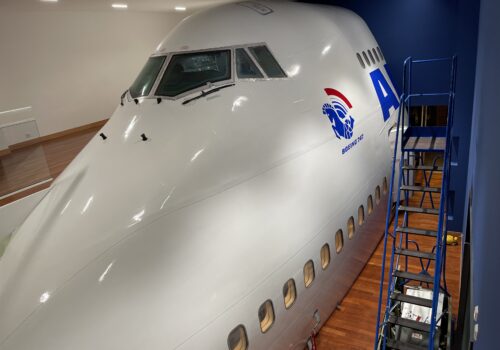
The Boeing 747 is an American jet airliner with a wide fuselage, often referred to by its nickname, Jumbo Jet or Queen of the Skies. Its characteristic « hump » at the front of the fuselage make the 747 a particularly recognizable device. The 747 is also the first wide-fuselage airliner aircraft produced. Built in the United States by the Boeing Group, the initial version of the 747 has a capacity two and a half times that of the Boeing 707, which is one of the major commercial aircraft of the 1960s. Put into service in 1970, the 747 held the passenger capacity record for 37 years, until the arrival of the Airbus A380.
The first edition of the jumbo jet, the 747-100, came out of the Everett assembly line (this factory was then the largest ever built) for a first flight on February 9, 1969 and certification in December of the same year. The 747-100 entered service in January 1970 for its first customer, Pan American World Airways. An evolution of the aircraft mass, the thrust of the engines and its range of action allowed the construction of the 747-100B. This evolution occurred as the 747-200 was already in production. In fact, only 9 copies of the 747-100B were built. Another variant of the 747-100, the 747-100SR (Short Range) is optimized for very short flights: with a capacity of 550 passengers, it is used on domestic flights in Japan.
Base 100 Series aircraft can travel just over 9,000 km on a full charge. The last aircraft delivered in this version was for the Japanese airline Japan Airlines in September 1986. The 747-100 passenger version can be distinguished from other versions by its upper deck, sometimes having only three portholes (a system of removable covers, the classic row of portholes also meeting). Some 747-100 had a second life after a modification to Special Freighter, a version never declined by Boeing. The entire cabin is equipped for cargo transport and a cargo side door is installed on the left side, between passenger doors 4 and 5. This type of aircraft does not have a nose door.
Introduced in 1972, the 747-200 has higher thrust turbojets and its structural mass is greater than that of the 747-100. Its larger capacity tanks give it a longer range of action. It is generally distinguished by its upper deck with eight portholes (some companies have purchased the S.U.D. modification – Streched Upper Deck: elongated upper deck – giving it the appearance of a B747-300). The 200 Classic series models, built in the early 1990s, can travel about 12,700 km at full load.
747-200B
An improved version of the standard 747-200, the 747-200B has a larger kerosene load and more powerful engines. Qantas took delivery as early as 1971. Its autonomy is 10,700 km. It should be noted that Boeing proposed to extend the upper deck of the B747-200, an aircraft that was named B747-200 SUD (Stretched Upper Deck). The French private company UTA had two transformed (F-BTDG and F-BTDH) under this version. The aircraft therefore had an upper deck of 300 with a straight staircase and a main bridge of 200 unmodified.
747-200C
The 747-200C (Combi) could either carry passengers or carry goods. Thanks to removable seats, it was possible to move it quite easily from a passenger configuration to a cargo configuration.
747-200F
The 747-200F (Freighter) only carries cargo. Loading is done either from the front (after lifting the nose), or through the cargo side door located on the left side between passenger doors 4 and 5. In 2011, many 747-200 are still operational. Some 747-200C (Combi) had a second life after a conversion to Special Freighter. The entire cabin is then intended for freight transport. This type of aircraft does not have a nose door, loading is only through the side cargo door, already existing, located on the left side.
747-200M
It could transport both passengers and goods. Unlike the 747-200C which transported either goods or passengers, the 747-200M could transport both at the same time while being limited to about 200 passengers.
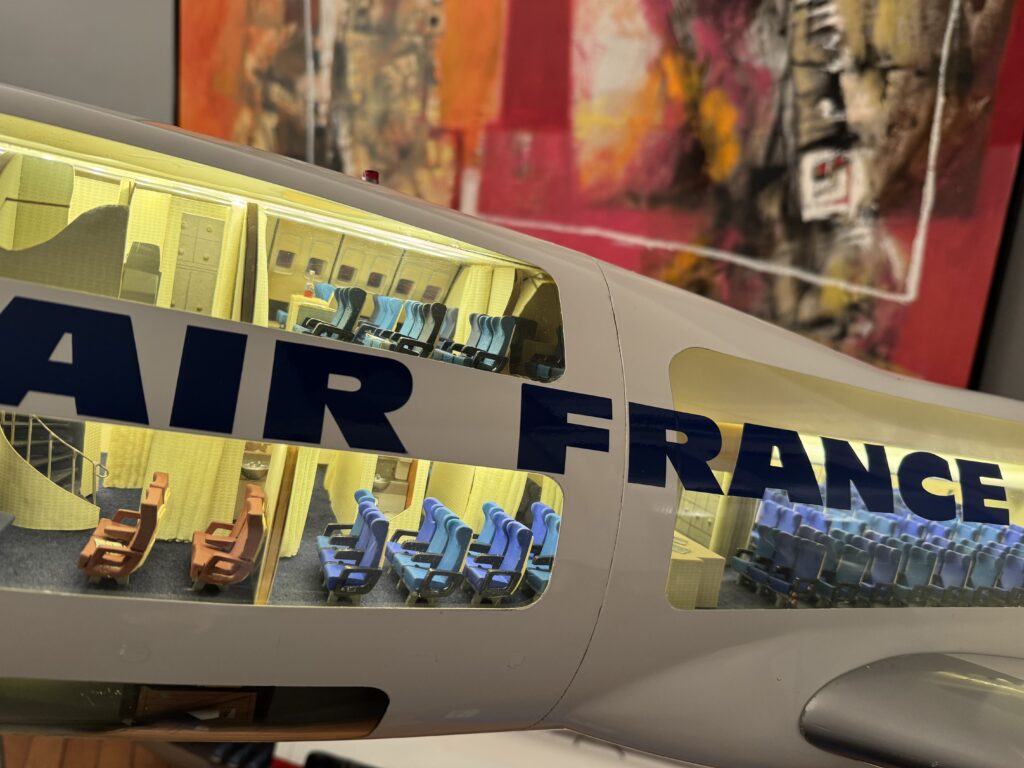
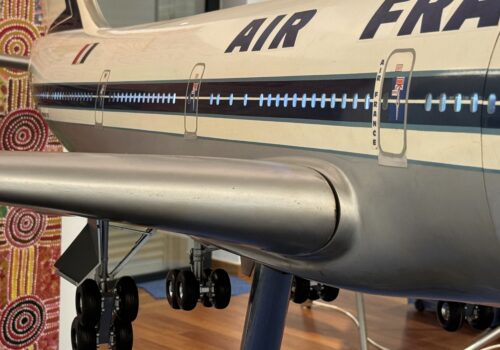
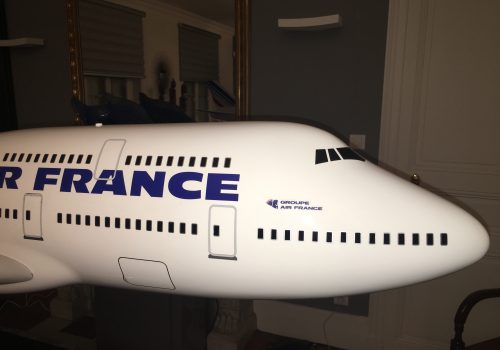
This is an Air France 1:32 scale agency model representing a Boeing 747, typical of those displayed in travel agencies during the 1980s. The model is impressive in size: at 1:32 scale, it measures approximately 220 cm in length, with a wingspan of about 180 cm and a total height of around 65 cm (from the ground to the top of the vertical stabilizer). It also features a detailed landing gear, perfectly reproduced, which enhances its realism when displayed.
Model dimensions
- Length: 2.20 m
- Wingspan: 1.80 m
- Height: 0.65 m
Composition
The model is made of resin, a high-quality material frequently used for these professional models, combining strength with precision and detail.
Interior description
The interior is highly detailed, intended for exhibition and educational purposes, with open sections on the left side allowing a view of the two-deck cabin.
- The main deck displays the different classes, with furniture typical of Air France in the 1980s.
- At the front: red seats for First Class (usually more spacious and refined), followed by a section with blue seats for Business and Economy Class, consistent with their position on the aircraft.
- On the upper deck: a specific layout, often dedicated to Business or First Class on 747s of that era.
- The model reflects the color scheme used by Air France at the time, with red seats for First/Business and blue seats for Economy, as well as a layout faithful to the actual Air France Boeing 747 configuration of the 1980s.
This model was designed both to present the aircraft—its capacity and equipment—and to attract clients in travel agencies by offering an immersive view of the Air France travel experience.
747-200B
747-200C
747-200F
747-200M
Period documents
Safety cards, model kit boxes, advertising and historical documents related to this aircraft.
Leave a comment