History and description
The Boeing 747 is an American jet airliner with a wide fuselage, often referred to by its nickname, Jumbo Jet or Queen of the Skies. Its characteristic « hump » at the front of the fuselage make the 747 a particularly recognizable device. The 747 is also the first wide-fuselage airliner aircraft produced. Built in the United States by the Boeing Group, the initial version of the 747 has a capacity two and a half times that of the Boeing 707, which is one of the major commercial aircraft of the 1960s. Put into service in 1970, the 747 held the passenger capacity record for 37 years, until the arrival of the Airbus A380.
The first edition of the jumbo jet, the 747-100, came out of the Everett assembly line (this factory was then the largest ever built) for a first flight on February 9, 1969 and certification in December of the same year. The 747-100 entered service in January 1970 for its first customer, Pan American World Airways. An evolution of the aircraft mass, the thrust of the engines and its range of action allowed the construction of the 747-100B. This evolution occurred as the 747-200 was already in production. In fact, only 9 copies of the 747-100B were built. Another variant of the 747-100, the 747-100SR (Short Range) is optimized for very short flights: with a capacity of 550 passengers, it is used on domestic flights in Japan.
Base 100 Series aircraft can travel just over 9,000 km on a full charge. The last aircraft delivered in this version was for the Japanese airline Japan Airlines in September 1986. The 747-100 passenger version can be distinguished from other versions by its upper deck, sometimes having only three portholes (a system of removable covers, the classic row of portholes also meeting). Some 747-100 had a second life after a modification to Special Freighter, a version never declined by Boeing. The entire cabin is equipped for cargo transport and a cargo side door is installed on the left side, between passenger doors 4 and 5. This type of aircraft does not have a nose door.
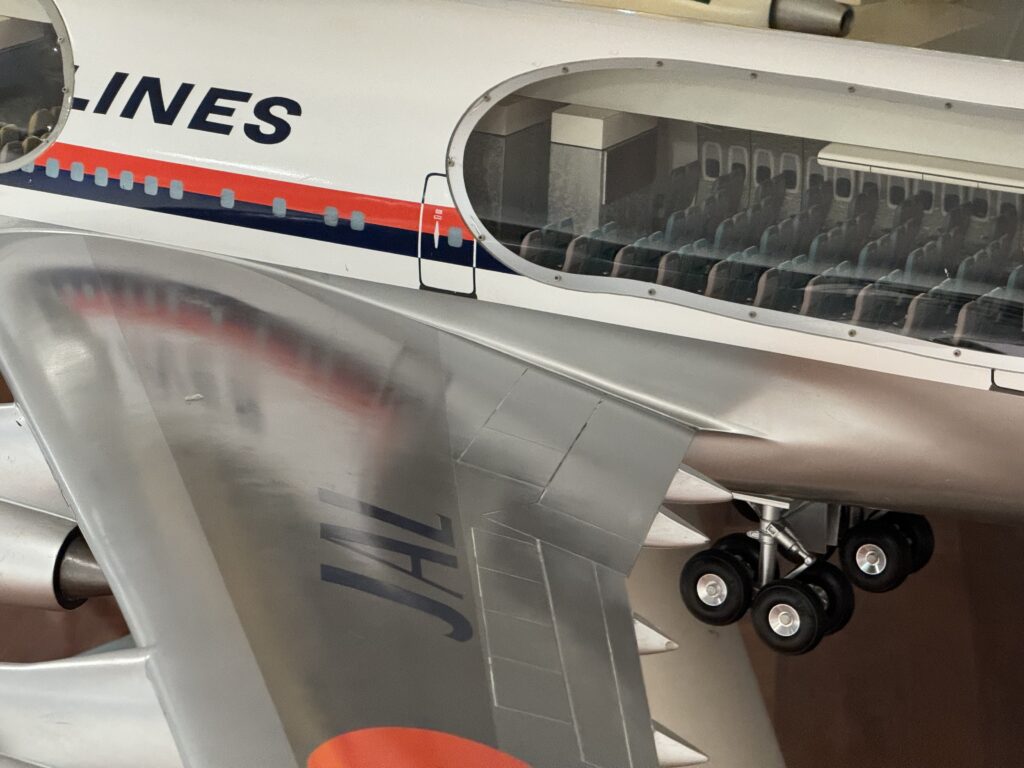
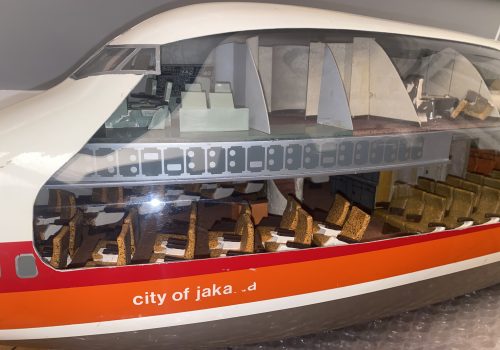
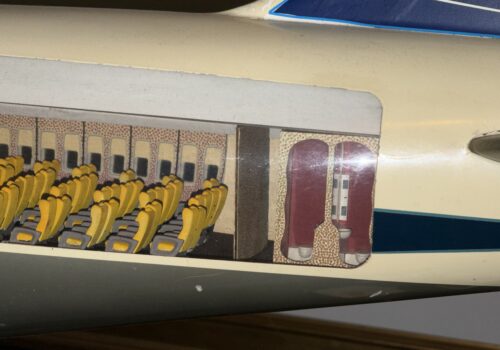
This is an agency display model representing a JAPAN AIRLINES Boeing 747 at a 1/24th scale. It features a detailed longitudinal cutaway interior (cut open to show the cabins and layout), typical of the models used in JAPAN AIRLINES travel agencies during the 1970s–1980s to promote the aircraft’s comfort and capacity.
Dimensions of the 1/24th scale model :
The actual length of a Boeing 747-100 is approximately 70.6 meters; therefore, at a 1/24th scale, the model measures approximately:
- • Length: 2.94 meters
- • Wingspan: 2.48 meters
- • Height: 0.80 meter
These dimensions are calculated by applying the 1/24th scale to the actual dimensions of a 747-100 (length 70.6 m, wingspan 59.6 m, height 17.06 m).
Historical details and features :
- Such large models were frequently displayed in the halls or shop windows of JAPAN AIRLINES agencies located in airports and major cities.
- The side cutaways made it possible to show the arrangement of all cabin classes, lounges, and crew-rest areas.
- These models were made to order by specialized craftsmen or model makers, with a high level of exterior and interior detail.
Such models have become rare and are highly sought after by collectors, or belong to museum collections and the premises of aerospace companies.
Maquette Boeing 747-100 JAPAN AIRLINES immatriculé JA8101 à l’échelle 1/24ème avec vue en coupe et trains d’atterrissage
Period documents
Safety cards, model kit boxes, advertising and historical documents related to this aircraft.
Leave a comment