
History and description
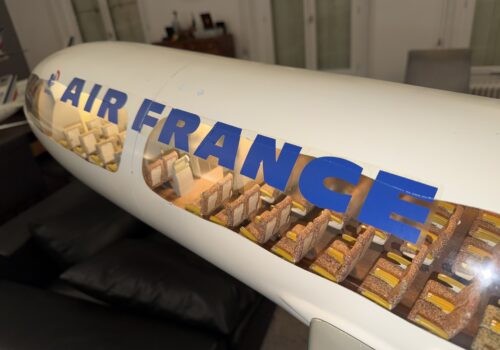
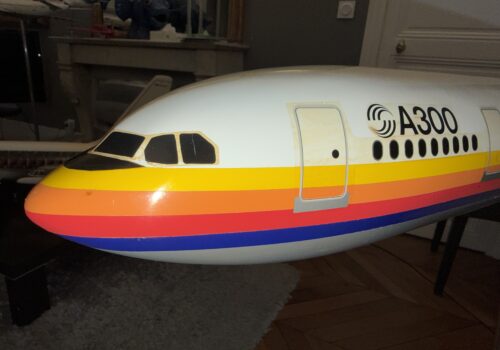
The Airbus A300 is a family of wide-body airliners built by Airbus from 1972 to 2007. The A300 is at the origin of the creation of the Airbus group and is its first marketed model. The Airbus 300 B2 was the first production model, it entered service in May 1974 for Air France. Following the arrival of Pratt & Whitney’s reactors, the manufacturer announced a name change. This was a more logical name, depending on the version, the engine manufacturer and its variant (today, 00-General Electric, 10-CFM International, 20-Pratt & Whitney, 30-International Aero Engines, 40-Rolls-Royce, 50-CFM International (neo), 60-Engine Alliance, 70-Pratt & Whitney (neo) and 80-Europrop International).
The A300B2-100 was the first commercial series version with a short range of action with 137 metric tons of maximum mass at takeoff. Air Inter was one of the first and main customers of this model. In 1979, the French company was attacked because of its high fares. In addition, on September 22, 1981, the SNCF inaugurated its TGV service between Paris and Lyon. Air Inter had to adapt to this situation. In order to increase its productivity, the capacity of the aircraft was increased from 270 to 314 seats, by the removal of two galleys and by the development of nine front seats. Finally, Air Inter satisfactorily exploited 15 copies of the A300B2-1C, in particular by acquiring some used aircraft as well as 6 type B4 and a B2K-3C.
For the A300B2-201/203 models, Airbus developed the A300B2K-3C with the Krueger type spout, that of the B4 version, in order to improve performance during takeoff and landing. Thus, its maximum mass at take-off increased to 142 metric tons. The manufacturer offered this version to South African Airways to serve Johannesburg airport where the air density is still low, due to the altitude (1,700 m) and its high temperature. The first of the 4 copies (MSN32) was delivered on November 15, 1976. As this aircraft was equipped with General Electric CF6-50C2 reactors (2×230.5 kN during takeoff, 2×206.0 kN after) Airbus sold under the name A300B2-203. He also sold 8 copies to Iran Air, 3 copies to VASP and MSN112 for Air Inter, probably due to a cancellation. In addition, 9 other A300B2K-3C were built for Toa Domestic Airlines which was to serve a number of airports with short runways. The General Electric CF6-50C2R reactor (R: reduction) equips these A300B2K-3C, reducing its thrust. Airbus was waiting for more orders for this A300B2-201 version. But, pending the delivery of the A300B4-622R, the company preferred to buy several used A300B4-203, to take advantage of a large community between aircraft. The A300B2-201 was never delivered.
The A300B2-320 was the first Airbus aircraft powered by the Pratt & Whitney reactor, JT9D-59A (2×230.2 kN during takeoff, 2×199.2 kN after). Its masses at no time and on landing were increased. Scandinavian Airlines System, which had a maintenance center for this type of engine at Arlanda airport, received the first of its A300B2-320 on January 15, 1980, in order to optimize its flight capacity between Scandinavian capitals. After all 4 copies were converted to A300B4-120 in 1983, Scanair, its charter subsidiary, benefited from improved autonomy.
In 2014, only six B2 aircraft were operated. They were 3 B2-203 from Iran Air and 3 B2K-3C from Mahan Air. Following the replacement of the Airbus A300 ZERO-G since October 2014, it seems that the operation of the A300B2 has almost been completed.
Period documents
Safety cards, model kit boxes, advertising and historical documents related to this aircraft.



Leave a comment