History and description
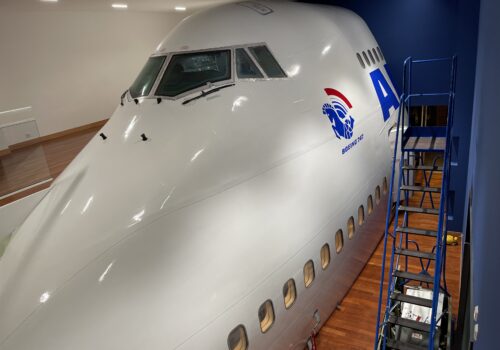
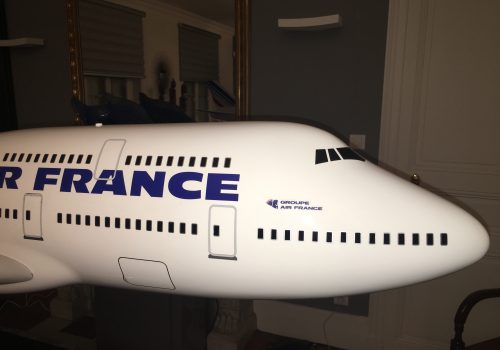
The Boeing 747 is an American wide-body jet airliner, often referred to by its nicknames, Jumbo Jet or Queen of the Skies. Its distinctive “hump” at the front of the fuselage makes the 747 a particularly recognizable aircraft. The 747 was also the first wide-body airliner ever produced. Built in the United States by the Boeing group, the original version of the 747 had a capacity two and a half times greater than that of the Boeing 707, one of the major commercial aircraft of the 1960s. Entering service in 1970, the 747 held the record for passenger capacity for 37 years, until the arrival of the Airbus A380.
The first edition of the jumbo jet, the 747-100, rolled off the Everett assembly line (then the largest building ever constructed) for its maiden flight on February 9, 1969, and was certified in December of that year. The 747-100 entered service in January 1970 with its first customer, Pan American World Airways. An increase in the aircraft’s weight, engine thrust, and range led to the development of the 747-100B. This evolution took place while the 747-200 was already in production. As a result, only nine examples of the 747-100B were built. Another variant of the 747-100, the 747-100SR (Short Range), was optimized for very short flights: with a capacity of 550 passengers, it was used on domestic routes in Japan.
Basic 100-series aircraft can travel just over 9,000 km with a full load. The last aircraft delivered in this version went to Japan Airlines in September 1986. The passenger version of the 747-100 can be distinguished from other variants by its upper deck, which sometimes has only three windows (a removable cover system was used, though the normal row of windows also appeared). Some 747-100s had a second life after being converted into Special Freighters, a version never officially offered by Boeing. The entire cabin was modified for cargo transport, and a side cargo door was added on the left side, between passenger doors 4 and 5.
This type of aircraft does not have a nose door.
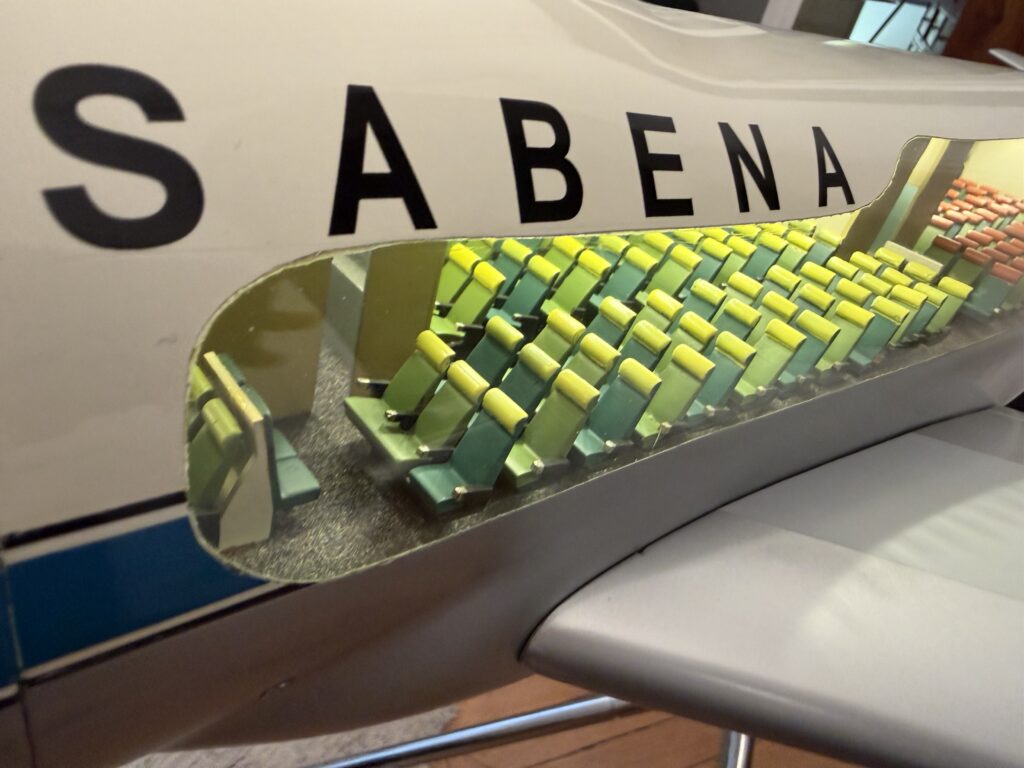
This Sabena agency display model represents a Boeing 747, built at a 1/50 scale. It stands out for its high degree of accuracy, both in its external proportions and in the meticulous reconstruction of its cabin—typical of Sabena at the time.
Exact dimensions
At a 1/50 scale, a Boeing 747-100 measuring about 70.6 meters in length and 59.6 meters in wingspan results in a model approximately:
- Length: 142 cm
- Wingspan: 120 cm
- Height: about 25 cm
These dimensions correspond to the large “cutaway” presentation models used in travel agencies during the 1970s and 1980s to show clients the aircraft’s interior layout and seating capacity.
Exterior features
- Historic livery: the model bears the iconic blue and white Sabena colors, with the blue side stripe, the stylized tail logo, the “SABENA” name, and the Belgian flag on the forward fuselage.
- Registration number: the model displays the code OO-SAB, matching one of the actual aircraft from the fleet.
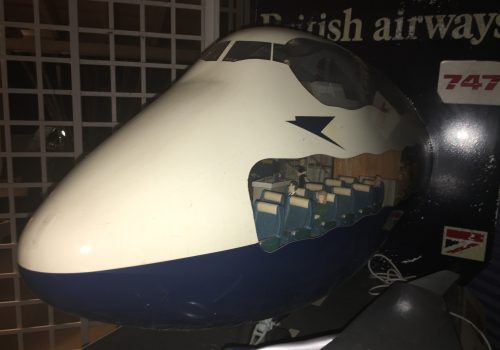
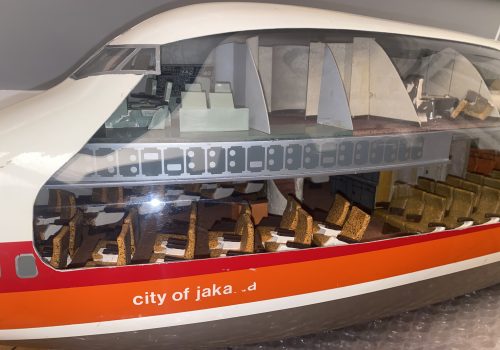
- Cutaway fuselage: a large transparent side panel reveals a panoramic view of the cabin along the entire length, typical of models made for travel agencies to showcase the onboard experience.
Cabin interior decoration
The recreation of the cabin’s interior decor, very representative of Sabena’s 1970s–80s style, is particularly remarkable:
- Two-tone seat layout: in economy class, the rows of seats alternate between moss green and pastel turquoise, with contrasting headrests and armrests in lemon yellow or sky blue depending on the section, giving the cabin a bright, graphic identity.
- Red headrests: in one section, the seat backs feature an orange-rust headrest cover, a detail characteristic of Sabena’s cabin fittings of that era.
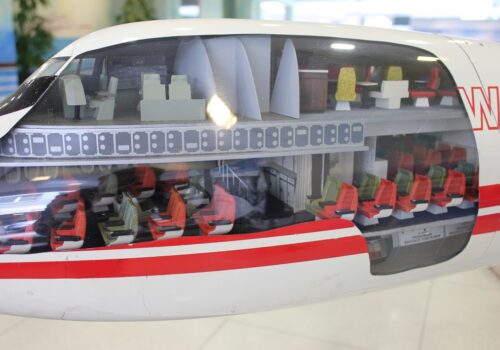
- Upper classes (first/business class, at the front): the wider, two-tone seats (ruby red and beige) are arranged in a less dense configuration, often in pairs or small groups, evoking the comfort of the lounges of the time.
- Upper-deck lounge: visible on the model, it is furnished with red armchairs, coffee tables, and bar-style furniture, reproducing the legendary “upper deck lounge” of the first 747s, originally designed as a social space before the advent of the “all-economy” configuration.
- Partitions and carpets: the divisions between the different classes and sections are clearly visible, with white or beige partitions, red carpeting in premium areas, and a speckled gray aviation-style carpet on the main deck.
- Galley/bar and stairs: the model includes the galley area, reproduced with white or cream furniture, and the spiral staircase leading to the upper-deck lounge at the front of the cabin—a signature feature of the first 747s.
Sabena atmosphere fidelity
The entire piece perfectly captures the Sabena aesthetic: northern European sobriety, vivid yet harmonious color palette, and a functional, welcoming design. The typical 1970s layout, with a large upper-deck lounge and a colorful economy section, is faithfully represented, making this model a precise testimony to the era of long-haul air travel as Sabena presented it to its clients during the golden age of the Jumbo Jet.
In summary, this 1/50 scale Sabena Boeing 747 travel-agency model is a rare collector’s piece—an evocative blend of technical precision and period design, remarkable for its faithful interior detailing, from the upper-deck lounge to the vividly colored passenger cabins typical of Belgium’s great national airline.
Period documents
Safety cards, model kit boxes, advertising and historical documents related to this aircraft.
Leave a comment